
Introduction and objectives of the guide
In modern industry, plastic materials play an essential role in the design of technical parts, logistical solutions, and packaging.. Among the available processing techniques, thermoforming has established itself as a particularly effective technology for producing lightweight, strong, and economically optimised parts.
Used in industrial logistics, automotive, electronics, and packaging, thermoforming can meet very diverse needs (product protection, organisation of logistics flows, machine cladding, or the manufacturing of technical parts). However, despite its importance in the plastics industry, this process is sometimes misunderstood. Some manufacturers associate it solely with food packaging or blister packs, whereas its applications now cover many industrial sectors.
This guide has been designed, by the teams of RBL Plastiques, expert in custom-made plastic solutions since 1979,pour, Offer a clear, educational, and comprehensive overview of industrial thermoforming. The addresses industrial managers, engineers, technical buyers and design offices who wish to deepen their knowledge on the subject.
1/ What is thermoforming?
A plastic transformation technology
thermoforming is a procédé industriel qui consiste à chauffer une plaque ou bobine de plastique thermoplastique jusqu’à ce qu’elle devienne malléable, then to shape it using a mould. Once cooled, the material retains the shape obtained.
This process is distinguished from others plastic processing technologies thanks to its relative simplicity and flexibility. Unlike plastic injection, which requires injecting molten material under pressure into a closed mould, Thermoforming uses plastic sheets or coils which have been previously extruded. This particularity directly influences tooling costs, speed of production, and design flexibility.
The main stages of the process
Even though the principle is relatively simple, thermoforming relies on a succession of mastered technical steps.
Chauffage de la plaque plastique ou bobine
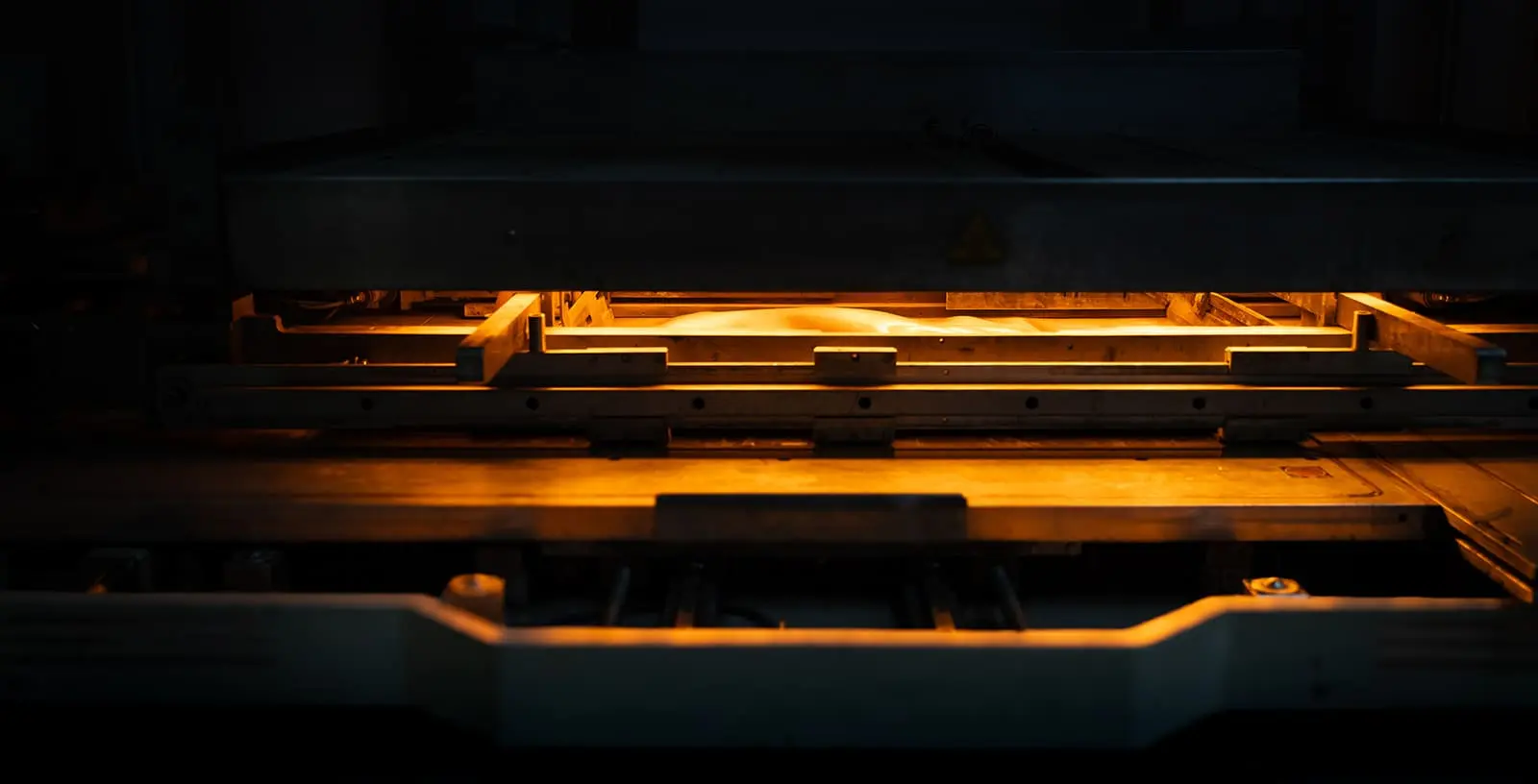
La plaque thermoplastique ou la bobine est placée dans une machine de thermoformage où elle est chauffée de manière homogène. La température dépend du matériau utilisé et doit être parfaitement contrôlée afin d’éviter toute dégradation de la matière.
Formatting
Une fois chauffée, la plaque ou bobine devient souple et peut être mise en forme sur un moule. Cette mise en forme peut être réalisée par aspiration d’air, pression d’air ou action mécanique.
Cooling
The part is held in the mould during its cooling phase to stabilise its structure and ensure the precision of its geometry.
Cutting and finishing
After forming, the workpiece undergoes various finishing operations: trimming, machining, drilling, or assembly.

2/ The different thermoforming technologies
Thermoforming encompasses several industrial techniques that rely on the same principle but use different shaping methods.
Vacuum forming
Vacuum forming is the most widespread technology in the industry. The principle involves sucking out the air located between the heated sheet and the mould. The vacuum created then presses the material against the surfaces of the mould.
This technique is particularly suited to logistics platforms, plastic packaging, and industrial protection solutions.
Pressure thermoforming
Pressure forming uses compressed air to push the material into the mould's features. This process allows for:
- A better accuracy of details
- An improved surface finish
- A more faithful reproduction of textures
It is notably used for aesthetic parts or technical applications.
Mechanical thermoforming
In some cases, a mechanical punch presses the material into the mould. This process is used for certain industrial parts requiring a specific geometry. To better understand the technologies used in plastics processing, resources from European Plastics Converters propose de nombreuses publications techniques.
3/ Materials used in thermoforming
The choice of material is an essential step in the success of a thermoforming project.
Each polymer possesses specific characteristics that influence the mechanical strength, rigidity, transparency, or thermal resistance of the part.
ABS
TheABS is an engineering polymer recognised for its impact resistance and rigidity. It is frequently used for industrial parts or machine housings.
Bio-based PLA
The PLA (Polylactic acid) is a bio-based polymer obtained from plant resources such as corn starch or sugar cane.
This material is attracting growing interest in industry due to its renewable origin and reduced environmental impact compared to some traditional plastics.
PMMA
The PMMA (Polymethyl methacrylate) is often known as Plexiglas. This material is distinguished by its high transparency and excellent surface quality. It is used to produce parts requiring a strong aesthetic dimension or perfect visibility.
The PET
The PET is one of the most used materials in thermoforming. It offers excellent transparency, good mechanical strength, and interesting recyclability.
It is particularly used in packaging and bottling applications.
Polystyrene
The Polystyrene It's an economical and easy-to-process material. It's often used for display trays or void fill solutions.
Polypropylene
The Polypropylene is valued for its chemical resistance and flexibility. It is often used in food or logistics applications.
PVC
The PVC (Polyvinyl chloride) is a polymer widely used in the thermoforming industry, particularly for the manufacture of blisters and technical packaging.
Pour mieux comprendre les propriétés des polymères industriels, découvrez les ressources de la Plastics Industry Association and our Complete catalogue of thermoformable materials used by RBL Plastiques.

4/ Industrial applications of thermoforming
Thermoforming is used across many industrial sectors. Its versatility means it can meet a wide range of needs.
Industrial logistics
In industry, vacuum-formed trays are widely used for organising and transporting components. They help to stabilise parts, prevent damage from impacts, and optimise space within logistics flows.
Automotive industry
In the automotive industry, thermoforming is used to produce interior trim parts, technical protectors, or insulation elements.
The lightness of thermoformed parts helps to reduce the weight of vehicles. Discover our Catalogue of thermoformed solutions for the automotive industry.
Medical industry
In the medical sector, thermoforming is used to produce surgical trays or sterile packaging.
Industry, communication and point-of-sale displays
thermoforming is also widely used in the Manufacture of POS displays (Point of Sale Advertising) and visual communication elements.
Cosmetics industry
In this sector, thermoforming allows for the reconciliation of product protection, aesthetics, and logistical optimisation. This process is notably found in Manufacture of packaging trays, display blisters, inserts for boxes or protective holders for bottles or accessories
5/ The benefits of thermoforming for manufacturers
A reduced initial investment
thermoforming requires moulds less complex than plastic injection. Tooling costs are therefore generally lower. This allows manufacturers to launch projects with controlled investment.
Great production flexibility
Thermoforming is particularly suitable for small and medium runs. Design modifications can be made quickly.
A rapid market launch
The relative simplicity of the process allows for To reduce the lead times between the design of a part and its production.
6/ The steps of thermoforming manufacture
The thermoformed part manufacturing does not limit itself to the Plastic sheet formatting. Dans un contexte industriel, la Production of a series involves several successive steps that help secure quality, optimise costs, and ensure the repeatability of the process.
Each project generally follows a structured process ranging from needs analysis to industrialisation and the logistical management of the produced parts.
1. Needs analysis and project study
The first step is to to precisely understand the project constraints (use of the part, industrial environment, mechanical requirements, logistical constraints or economic objectives).
This phase allows us to determine:
- The function of the room
- Usage restrictions
- Production volumes
- The quality requirements
This study phase is essential for guiding technical choices and avoiding costly modifications during development. Discover our expertise: needs analysis.
2. Room design
Once the needs have been identified, the design phase allows the geometry of the thermoformed part to be defined.
Engineers take into account several parameters specific to thermoforming, including draft angles for ease of removal from the mould, material distribution, part rigidity, and mechanical stresses.
The design must also take into account the stretching of the material in order to obtain a homogeneous and robust part.
3. Choice of thermoformable materials
The choice of material is a key element of the project. Each polymer possesses specific properties that influence the behaviour of the final part.
The main selection criteria are:
- Mechanical strength
- Thermal wear
- Chemical resistance
- Aesthetics
- Recyclability
According to the application, The materials used can be PET, PS, PP, ABS or other polymers techniques. Explore our Catalogue of thermoformable materials.
4. Tooling design and manufacture
Before commencing production, it is necessary to design the mould which will be used to form the pieces.
According to the applications, the moulds can be made Aluminium, technical resin or in other materials suitable for production.
5. Prototyping Phase
Before producing a full series, it is often necessary to To produce a prototype or a pre-series.
This phase allows for:
- Validate the design
- Check the tolerances
- Test the resistance of the part
- Adjust certain manufacturing parameters
The prototyping constitutes an important step to secure the industrial launch.
6. Thermoforming: thin or thick gauge
The production of the parts can then commence. Depending on the thickness of the material used and the technical constraints of the project, two main approaches can be employed:
- The thin-gauge thermoforming, generally used for packaging, logistics trays, or certain lightweight parts.
- The heavy-gauge thermoforming, more commonly used for industrial parts, technical casings or certain structural applications.
In all cases, mastery of the process allows for parts that meet industrial requirements to be obtained.
7. Industrialisation of production
Once the production parameters have been validated, the fabrication can be launched in series. During this phase, the actions taken will aim to optimise production cycles and guarantee the quality of the parts.
Theindustrialisation enables the production of repeatable parts for small and large series.
8. Assembly and finishing operations
Some parts require additional operations after thermoforming, such as’assembly subsets,the integration of accessories, drilling or finishing operations.
These steps result in parts that are ready to be integrated into industrial processes.

7/ Thermoforming and environmental challenges
ThePlastics industry is today faced with major environmental challenges. Thermoforming can therefore contribute to reducing the environmental footprint of certain industrial applications.
Material optimisation allows for the production of lightweight parts while maintaining their mechanical performance. Furthermore, the’use of recycled or recyclable plastics progresses in many applications.
At RBL Plastics, we are ahead of the curve on this subject through our programme RBL Recycle who aims for revaluation of materials and the integration of recycled materials as the Bio-based PLA in the manufacturing process.
Glossary of thermoforming
Thermoplastic
Plastic material that can be heated, formed and cooled several times without losing its properties.
Plastic plaque
Sheet of thermoplastic material used as a raw material in thermoforming.
Mould
Tooling used to shape the thermoformed part.
Vacuum forming
Vacuum forming process using air suction to draw the material against the mould.
Pressure-forming
Technique using compressed air to push material into the mould's reliefs.
Image masking
Operation consisting of cutting the thermoformed part to obtain its final shape.
Draft angle
Built-in draft in the design of a part to facilitate mould removal.
Nominal thickness
Initial thickness of the plastic sheet before thermoforming.
Material stretching
A phenomenon that occurs when material stretches to take the shape of the mould.
Thermoformed tray
Plastic support used to organise or transport parts.
Blister
Transparent packaging used to protect and present a product.
Timing
Protection solution for stabilising a product during transport.
Tools
All moulds and equipment needed for production.
Plastics manufacturing
Industrial sector encompassing plastic processing technologies.
Extrusion
Process for producing plastic sheets used in thermoforming.